
It’s one of the most common questions I get:
“Do I really need to extract teeth for braces?”
I wish there were a simple yes-or-no answer. But the truth is, “to extract or not to extract” has been a century-old debate in orthodontics.
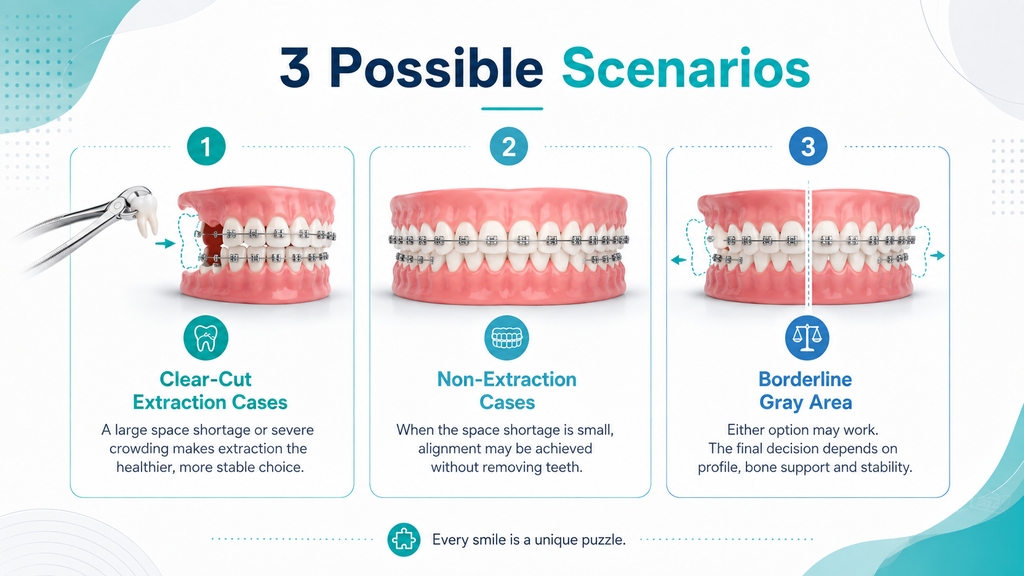
Every smile is a unique puzzle, and whether tooth extraction is necessary depends on much more than how crowded your teeth look.
Generally, patients fall into three different scenarios:
- Clear-Cut Extraction Cases: Where removing teeth is necessary to achieve a stable, healthy bite.
- Non-Extraction Cases: Where enough space can be created to align the teeth without removing any teeth.
- The Borderline Gray Area: Where either approach may potentially work and the orthodontist needs to carefully weigh the advantages and disadvantages.
So, how do we make the final decision?
Let’s break down what goes through an orthodontist’s mind when deciding whether those teeth should stay — or go.
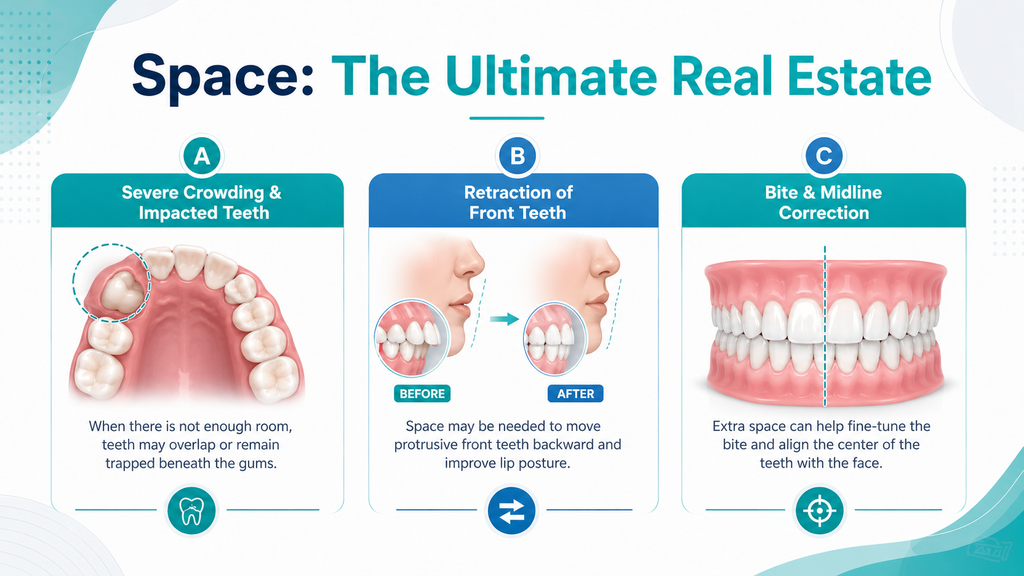
Space: The Ultimate Real Estate
When it comes to orthodontic treatment, space is one of the most important considerations.
If there isn’t enough room to move the teeth into their ideal positions, we need to create that space somehow.
There are several common reasons why additional space may be required.
A. Severe Crowding and Impacted Teeth
When the jaw is too narrow or the teeth are too large for the available space, the teeth simply cannot line up properly.
This results in crowding, where teeth may overlap, rotate or grow out of position.
In more severe cases, a tooth may become impacted — meaning it becomes trapped beneath the gums because there is simply no physical space for it to erupt properly.
B. Retraction of the Front Teeth
Sometimes the teeth may already be relatively straight but still flare outward.
In these situations, we may need space to move the front teeth backward.
This can be particularly useful for:
Reducing an Overjet
An overjet occurs when the upper and lower front teeth are positioned too far apart from front to back.
Creating space allows the orthodontist to move the front teeth into a better relationship.
Improving Lip Posture
When the front teeth protrude significantly, the lips may struggle to close naturally.
Retracting the teeth can allow the lips to relax into a more natural position and may improve the overall facial profile.
C. Correcting the Bite and Midline
Extra space can also be used to fine-tune the bite.
For example, an orthodontist may need to shift teeth sideways to correct a deviated dental midline, ensuring that the centre of the front teeth is better aligned with the face.
Space can also be used to adjust the relationship between the upper and lower back teeth to achieve a healthier and more functional bite.
How Do Orthodontists Create Space?
If we determine that more space is needed, tooth extraction is not our only option.
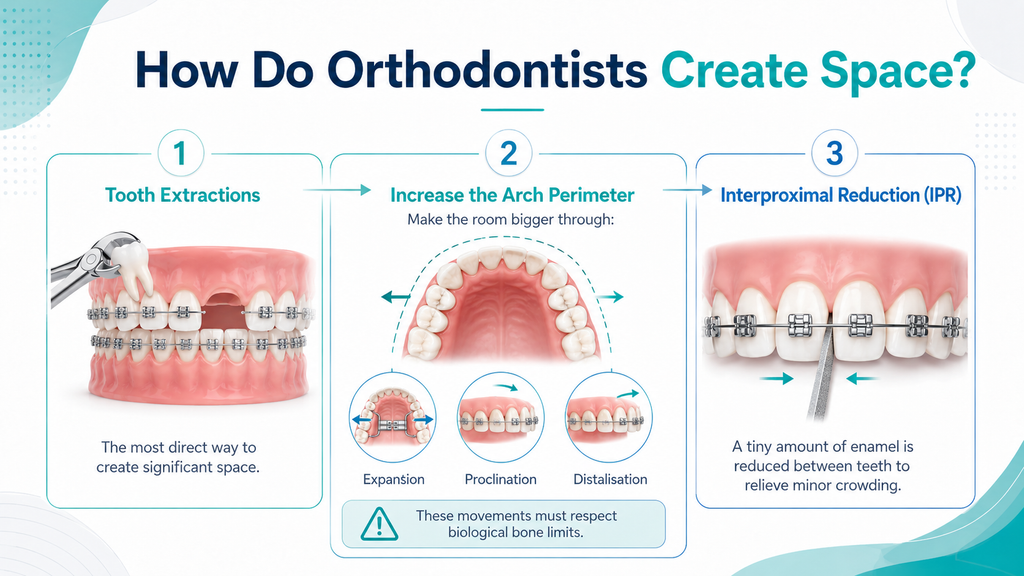
Orthodontists generally have three main strategies for creating additional room.
1. Tooth Extractions
Extraction is the most direct way to create a significant amount of space.
Although different teeth may be selected depending on the individual case, premolars are commonly chosen because of their location within the dental arch.
The space created can then be used for alignment, retraction or bite correction.
2. Increasing the Arch Perimeter
Another option is to try to make more room within the dental arch itself.
There are several ways this can be done.
Arch Expansion
Expansion involves widening the dental arch.
This can sometimes be achieved by moving the teeth outward or, in appropriate cases, through skeletal expansion of the jaw itself.
However, there are biological limits.
Bone does not have unlimited capacity.
If teeth are pushed too far outside their supporting bone, this may compromise the surrounding tissues.
Proclination
Proclination means moving or tipping the front teeth forward.
This can create additional space for alignment.
However, just like expansion, this approach is limited by the amount of supporting bone available around the teeth.
Excessive movement can increase the risk of gum recession or bone loss.
Distalisation
Distalisation involves moving the back teeth further backward.
One potential limitation is the presence of wisdom teeth, which may sometimes need to be removed before the other teeth can be moved backward effectively.
3. Interproximal Reduction (IPR)
Interproximal Reduction — commonly known as IPR — can be thought of as carefully “slenderising” the teeth.
A very small amount of enamel is reduced from the sides of selected teeth.
This creates small amounts of additional space and can be very useful for managing mild crowding without extracting teeth.
The amount that can safely be removed depends on factors such as the tooth’s position and enamel thickness.
How Do We Justify the Decision to Extract?
When teeth are crowded, the missing space has to come from somewhere.
This is where detailed orthodontic treatment planning becomes important.
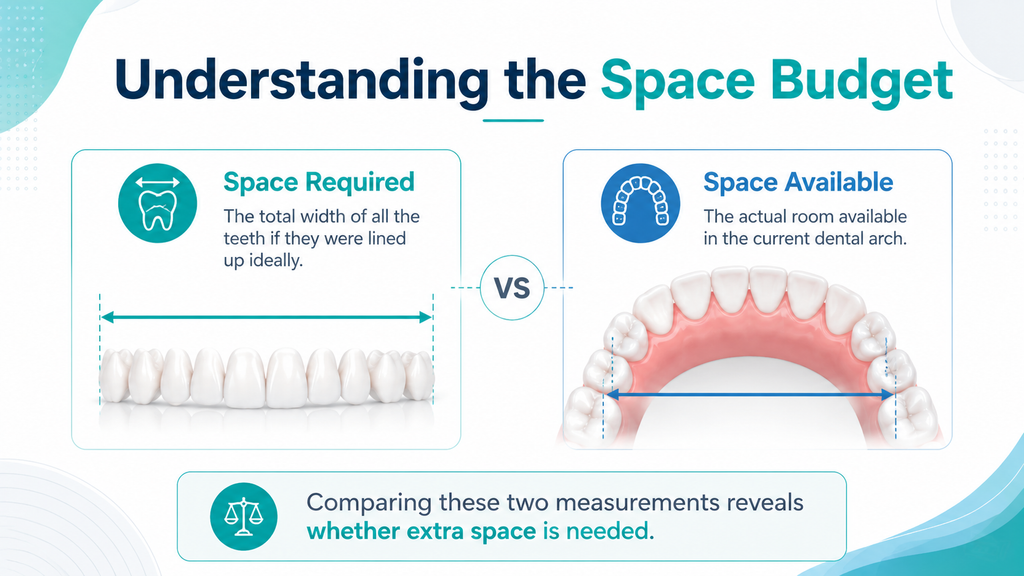
During your initial assessment, diagnostic records such as digital scans or study models allow us to evaluate what could be described as your “space budget.”
We compare two measurements:
Space Required
This refers to the total amount of room needed for all the teeth to line up properly.
Space Available
This refers to the actual amount of room currently available within your dental arch.
By comparing the two, we can determine whether there is a space shortage — and approximately how much additional room is required.
What Does This Look Like in Real Life?
Let’s look at a few simplified examples.
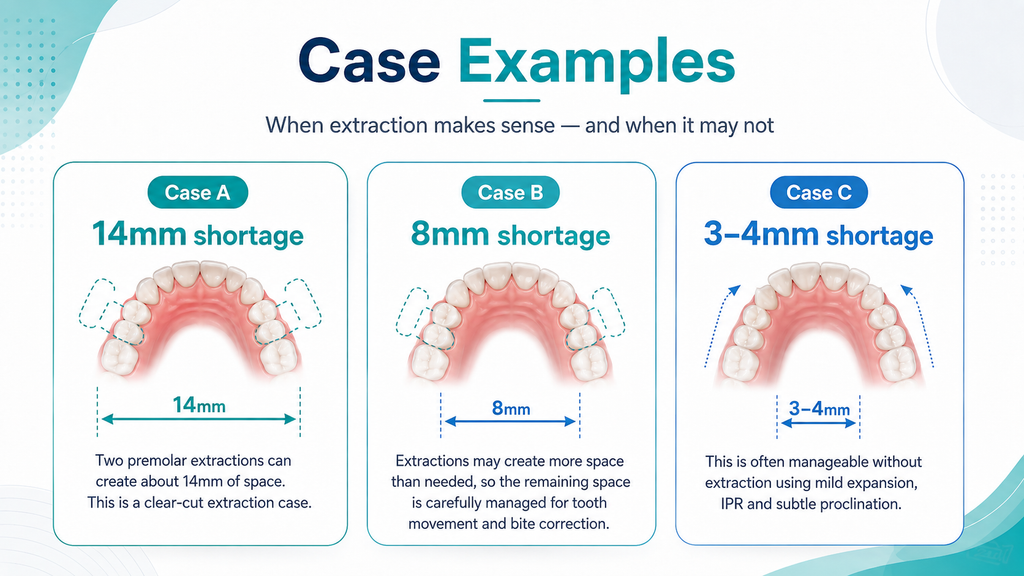
Case Scenario A: The Clear-Cut Extraction Case
Imagine a patient with severe crowding and a calculated space shortage of approximately 14mm in one arch.
An average premolar is approximately 7mm wide.
Removing two premolars would therefore create approximately:
2 × 7mm = 14mm of space
In this simplified example, the amount of space created closely matches the amount required.
This makes the reasoning behind extraction relatively straightforward.
Case Scenario B: The “Excess Space” Challenge
Now imagine that the space shortage is only 8mm.
If two premolars are extracted and approximately 14mm of space is created, there would be around 6mm of additional space remaining.
An orthodontist does not simply leave this space behind.
Instead, the braces are carefully designed to use it.
For example, the extra space may be used to:
- Retract the front teeth slightly
- Allow the back teeth to move forward
- Improve the bite relationship
- Balance the overall dental and facial appearance
Treatment must also be planned carefully to avoid excessive retraction, which could negatively affect the patient’s facial profile.
Case Scenario C: The Non-Extraction Alternative
If the space shortage is relatively small — for example, around 3mm to 4mm — extraction may not be necessary.
Instead, the orthodontist may combine several space-creating methods, such as:
- Mild arch expansion
- Slight proclination of the front teeth
- Interproximal Reduction (IPR)
Together, these methods may create enough space to successfully align the teeth without removing any teeth.
The Borderline Gray Area: Can We Avoid Extractions?
This is where the decision becomes more complicated.
A borderline case occurs when the amount of crowding is not severe enough to make extraction an obvious choice, but there is still too much crowding to easily align the teeth without creating additional space.
Naturally, patients often ask:
“Can’t we just combine expansion, proclination and IPR so I don’t have to extract any teeth?”
Technically, the answer may sometimes be yes.
But the more important question is:
Should we?
When non-extraction methods are pushed to their limits simply to avoid removing teeth, there may be trade-offs.
An orthodontist needs to carefully consider several factors.
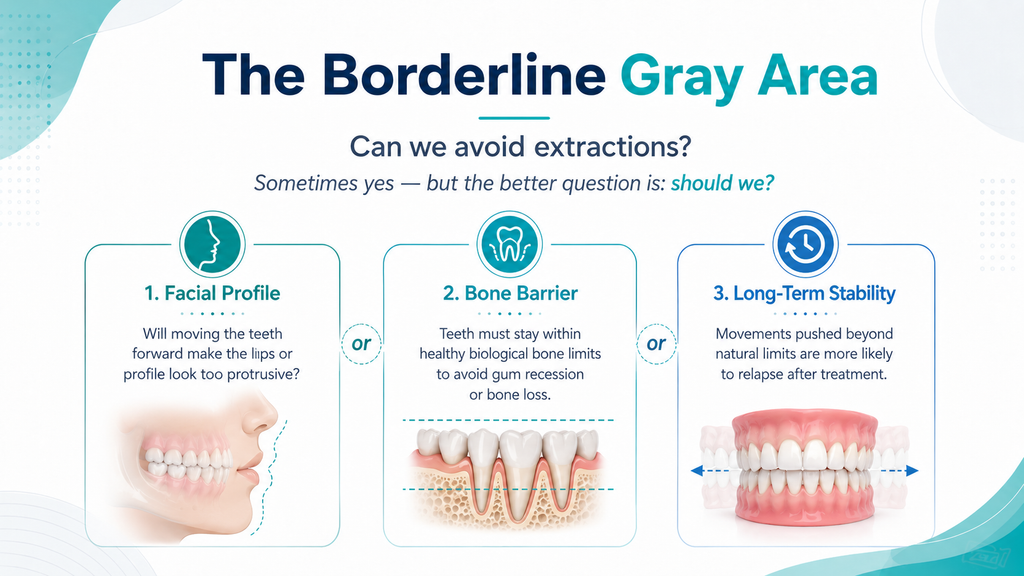
1. Facial Profile
Creating space through expansion or proclination can move the front teeth forward.
This may also push the lips outward.
For someone who already has a fuller or more protrusive facial profile, excessive forward movement may make the lips look even more prominent or make natural lip closure more difficult.
Therefore, the orthodontist must consider not only the teeth but also the patient’s overall facial appearance.
2. The Bone Barrier
Teeth need to remain within their supporting bone.
There is a biological limit to how far they can safely be moved.
Excessive expansion or proclination may position the roots too close to the outer boundaries of the bone.
This can increase the risk of problems such as:
- Gum recession
- Loss of supporting bone
- Compromised long-term periodontal health
3. Long-Term Stability
Orthodontic treatment isn’t only about making teeth straight.
We also want the result to remain as stable as possible after treatment.
When teeth are pushed beyond their natural biological boundaries, they may have a greater tendency to move back toward their original positions after the braces are removed.
That means a treatment plan that looks good initially may not necessarily be the most stable treatment in the long term.
Finding the Right Balance
In borderline cases, orthodontic treatment planning becomes both a science and an art.
We do not only look at digital scans or models of the teeth.
We also consider:
- Your facial profile
- Your smile aesthetics
- Your bite
- Your surrounding bone
- Your gum health
- The amount of crowding
- The long-term stability of the result
If the surrounding bone is healthy and the facial profile can comfortably accommodate a slightly fuller appearance, a combination of mild expansion, careful IPR and subtle proclination may allow us to achieve an excellent result without extractions.
However, if avoiding extraction would compromise gum health, push the teeth beyond safe biological limits or create an undesirable facial profile, strategic tooth extraction may ultimately be the healthier and more stable treatment choice.
The objective is not simply:
“Can we avoid extraction?”
The real objective is:
“Which treatment plan gives this patient the healthiest, most stable and aesthetically balanced result?”
Bonus Myth Buster: Braces vs. Clear Aligners
There is another common misconception worth addressing.
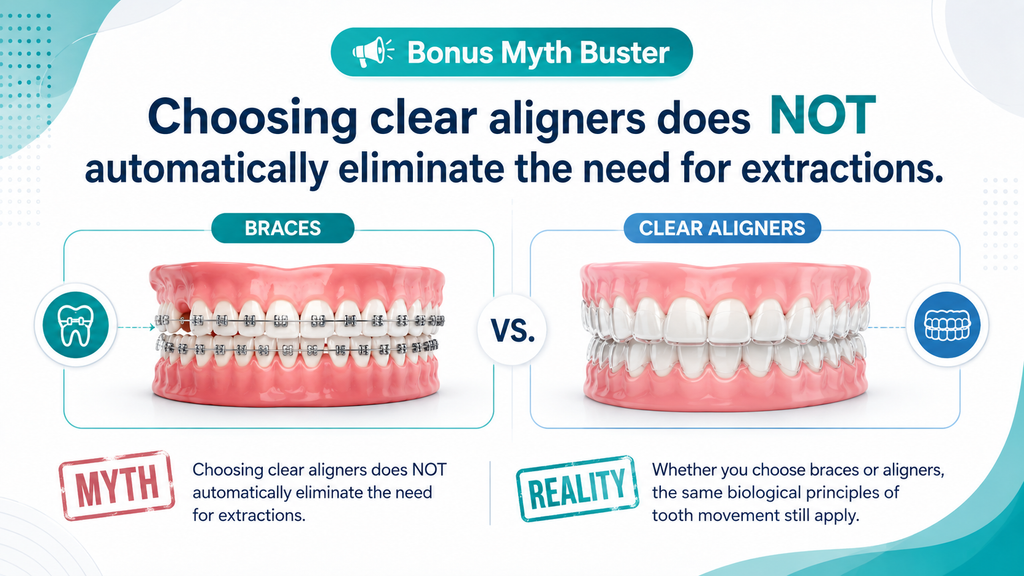
Some patients believe that choosing clear aligners instead of traditional braces automatically means they can avoid tooth extraction.
That isn’t necessarily the case.
Whether treatment is performed using braces or clear aligners, the same fundamental biological principles of tooth movement still apply.
If there is insufficient space within the dental arch, that space still needs to come from somewhere.
Depending on the individual case, this may involve:
- Expansion
- Proclination
- Distalisation
- IPR
- Tooth extraction
- Or a combination of these approaches
The appliance may be different, but the underlying orthodontic problem remains the same.
So, Do You Need Tooth Extractions for Braces?
There is no universal answer.
Some patients clearly benefit from extraction.
Others can achieve excellent results without removing any teeth.
And many patients fall somewhere in between.
That is why the decision should be based on a proper orthodontic assessment rather than simply choosing whichever option sounds more appealing.
A comprehensive treatment plan considers your teeth, available space, bite, facial profile, bone support and long-term stability before deciding on the best approach.
Not Sure Whether You Need Tooth Extractions for Braces?
Every orthodontic case is different.
If you have been advised to remove teeth for braces — or you are wondering whether a non-extraction treatment may be possible — a detailed orthodontic assessment can help you understand the reasons behind the recommended treatment plan.
Book an orthodontic consultation with Teh Orthodontics to discuss the treatment options for your smile.